Your finance function, reimagined
We tell you what to do next, then show you what it was worth.
A signed monthly board pack, with every decision sized in your own dollars. Every call we make is tracked against what the numbers did.
Built so you can be fully present in your business and your life.
- A few hours to set up
- Signed by a real advisor
- From $1,800/month
No email gate on the sample. The call is 20 minutes, no prep.

The problem
Plenty of numbers, and nobody turning them into decisions.
It usually shows up as cash. But cash is the symptom. By the time it's tight, the real issues have been building for months: margin slipping a point at a time, growth adding work faster than it adds profit. Your bookkeeper records what already happened. Your accountant arrives after quarter-end. Both look backward, and that's their job. The gap is that nobody's turning those numbers into decisions, forward.
Working harder for the same result.
Revenue's up; the balance isn't. Margin slips a point at a time, and nothing in the monthly reporting shows which contracts, customers or products make money.
Big calls, without the numbers.
Take the $800k contract? Add the headcount? Fund the expansion? At $5M these calls get expensive, and they land weeks before the reporting catches up.
No one looking forward.
Backward-looking books tell you where you've been. Nobody's modelling where you're headed, so the edge only becomes visible once you're at it.
The evidence
The data agrees: it's rarely only about cash. The two most common reasons Australian businesses fail sit side by side:
of company failures cite inadequate cash flow. The No. 1 cause.
ASIC insolvency statistics
cite poor strategic management. The No. 2 cause.
ASIC insolvency statistics
a year the average small business runs cash-flow-negative.
Xero Small Business Insights
businesses don't reach their fourth year of trading.
ABS business counts
Sources: ASIC annual insolvency statistics & REP 645; Xero Small Business Insights; ABS Counts of Australian Businesses (8165.0).
The conventional route
So you need finance leadership. The usual way to get it is expensive.
Someone has to turn the numbers into decisions. The standard playbook is to bolt on headcount, so cost and organisation chart grow before the clarity does.
Full-time CFO
salary and on-costs
Financial controller
salary and on-costs
Fahy Advisory
all in, no headcount
Salary ranges are indicative Australian market rates for the role, before on-costs, recruitment, and management time. Our range spans the Reporting and Advisory tiers.
Below about $10M, a full-time CFO is a six-figure salary for a part-time need.
What you get
A decision looks like this.
A specific call, sized in your own dollars, with the reasoning attached. We come back to it next month to see whether it worked.
From the August pack · Decisions
CashMove your three largest slow payers to 14-day terms this month.
- Why now
- Debtor days moved 47 → 58 over two months. Those three accounts are 61% of the balance over 60 days.
- Worth
- $180,000 released, roughly six weeks of payroll cover.
- Owner
- You, with your bookkeeper. Two conversations.
Next month, in the Decision Ledger: "Actioned on two of three accounts. Debtor days 58 → 51. $121K released against a $180K target. Chase the third."
Why it's built this way
-
Sized in dollars
Every recommendation carries a number, so you can rank it against everything else competing for your attention.
-
Someone owns it
Each one names who's doing it, because a decision nobody owns rarely gets done.
-
It gets followed up
Next month we show what it moved, including the calls that didn't land the way we expected.
Illustrative example using demo figures. Yours come from your own ledger.
Sample reports
See a real report, in your industry.
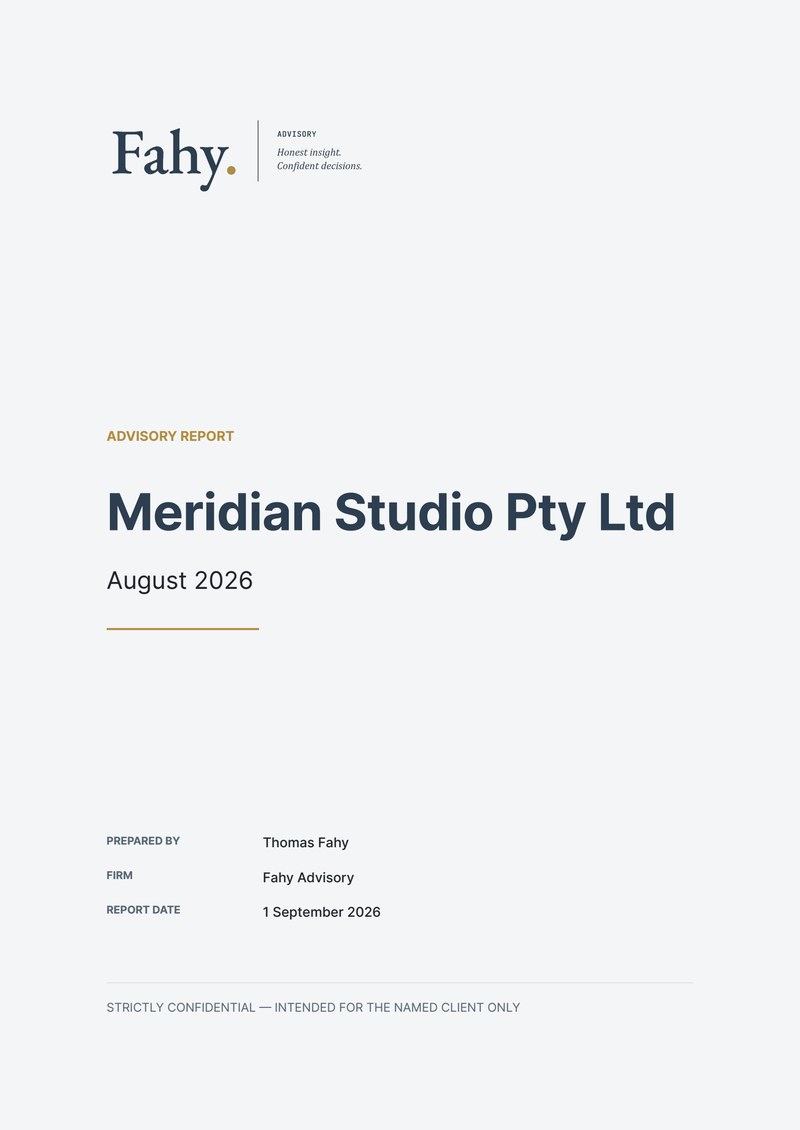
A monthly board pack built from realistic demo data. Pulse strip, Decision Ledger, our own forecasts checked against your books, an Engagement Scorecard tracking value added since day one, what each lever is worth in your dollars, strategic position, cash forecast scenarios, benchmarks, and the decisions for the month ahead. We work with all industries, and every pack is calibrated to the business in front of it.
Bayside Constructions, October 2026
Retention and work-in-progress tracked as standard, job-level margin, progress-claim discipline, and the statutory payment exposure a builder carries.
Download this sampleNo email gate. Free to download and share.
Meridian Studio, October 2026
Revenue and gross profit per head, billable utilisation, proposal win rate, and the client-concentration risk that comes with a handful of large accounts.
Download this sampleNo email gate. Free to download and share.
These two are only examples. We work with all industries. Your benchmarks, the operational measures we track and the language we use are all calibrated to the business you run. If your industry has a number that matters and these samples do not show it, tell us and we will talk it through.
Between packs
Your client portal, on every tier.
It's updated each cycle when your signed pack is published, and you can use it as much or as little as you like. It holds the month's headline and KPIs, every goal charted against its target, and every decision the packs have raised, with whether it worked.
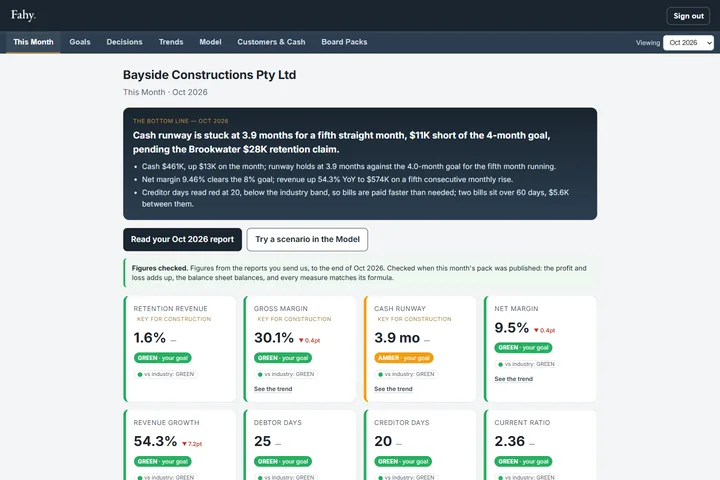
This Month
The headline and eight KPI tiles
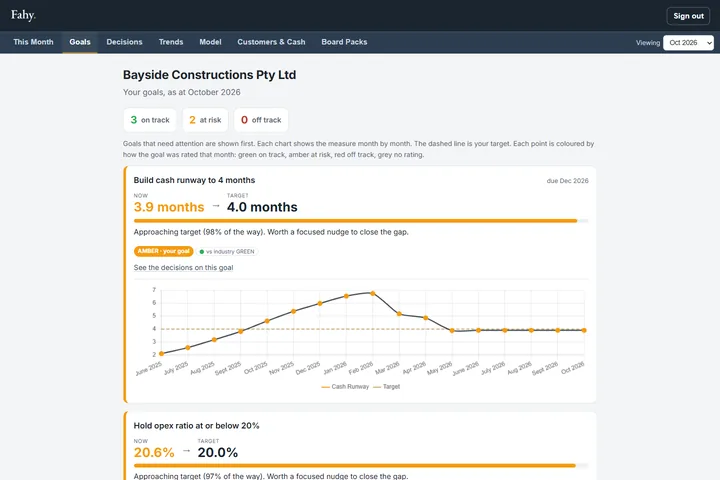
Goals
Each goal charted against its target
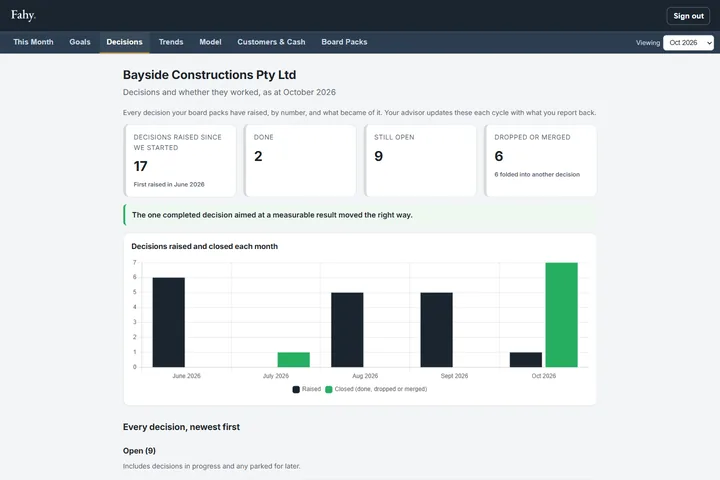
Decisions
What was done, and whether it worked
Screens from a demo business with made-up figures.
Your numbers
What could we help you find?
Set your revenue for a rough sense of the size of the prize. It's the shape of the arithmetic we'd run properly once we can see your actuals.
On industry averages, these three areas are typically worth
$340K to $490K
That's 9× to 14× a full year of Advisory at $36,000.
$274K
Cash freed from your debtor book
Paid around 10 days sooner
$100K
Extra profit
Net margin up one point
$40K
Overhead saved
2% off your overhead line
Three areas, and not the only three. Pricing, job and product profitability, working capital, headcount and capex timing all sit in the same monthly review. These are simply the easiest to size before we've seen your books.
It's an illustration only. The worked example uses generic industry assumptions. It isn't a forecast, a quote or advice about your business, and your own figures will be different.
The assumptions are generic: a debtor book around 50 days improved by 10, a one-point gain in net margin, and 2% taken off an overhead line assumed at 20% of revenue. Every business differs, which is what the range is for. The cash figure is a one-off release; the other two would recur annually. The same arithmetic is worked through on the pricing page. Nothing here is a substitute for looking at your actuals, which is what the discovery call is for.
Who we're for
Run the business and still have a life.
This is built for owners in any industry who are running a good business and carry it with them everywhere. What we build is the confidence to put it down when life asks, for a day or a fortnight, knowing it is under control and nothing financial will catch you cold. What that looks like is different for everyone. The list below is just the shape of it. Not sure yet? The FAQ covers the questions owners usually ask first.
- You want the finance thinking done at work, so your weekends belong to your family.
- You'd like a clearer view of cash before the month turns.
- You want to know which jobs, products or customers are really carrying the business.
- The big calls deserve more than a gut check: a hire, a contract, an expansion.
- You'd rather see what's coming than read about what already happened.
Insights
Short reads on the numbers that run a business.
Do I need a CFO or a financial controller?
A financial controller runs the finance function. A CFO decides with the numbers. What each one does day to day, which gap your business has, and the third option most owners never price: a strategic CFO on a fixed fee beside a strong bookkeeper.
Finance leadershipSetting up a monthly board pack for a small business: what goes in, and who should put it together
A practical guide for owners of small private companies: where the numbers come from, how to pick the six to eight that matter, when the pack should land, who should prepare and sign it, and what the first three months look like.
Finance leadershipThe 13-week cash flow forecast: how to see a cash crunch coming
Your bank balance tells you where you are today. It won't tell you where you'll be in six weeks. What a rolling 13-week cash flow forecast is, how to build one, and what to do when it shows a week you don't like.
So how does it work?
About three hours to get started, then a few hours of your time a month. Here's what you do, what we do, and how the first 90 days run.
Every pack reviewed and signed by Thomas Fahy, Brisbane.